
Guide three
Moon & Planets
The Moon and the bright planets are the easiest targets in the sky. They shine through light pollution and haze, and they change from night to night.
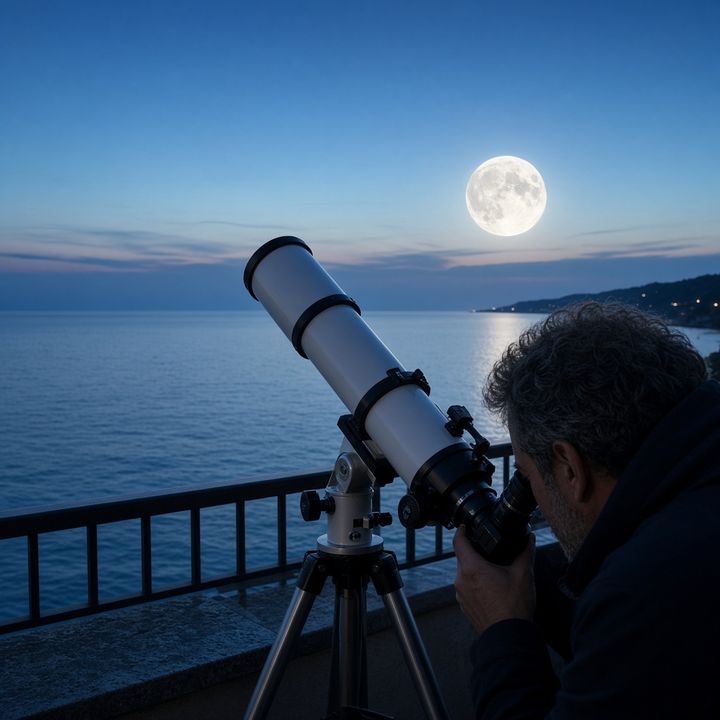
The Moon’s phases
The Moon goes through its cycle of phases in about 29.5 days. The best views of craters are not at full Moon but near the terminator, the line between day and night on the lunar surface, where long shadows show off the relief.
| Phase | When it is visible | Good for |
|---|---|---|
| Waxing crescent | Western sky after sunset | Earthshine on the dark part of the Moon |
| First quarter | Afternoon to around midnight | Craters along the terminator |
| Full | All night | Moonrise over the sea; bright ray systems |
| Last quarter | Around midnight to morning | Craters for early risers |
Earthshine
When the Moon is a thin crescent, you can often see the rest of its disc glowing faintly. That is sunlight reflected off Earth onto the Moon and back again.
The bright planets
- Venus: the brightest point of light after the Moon, seen in the west after sunset or the east before dawn. A telescope shows its phases.
- Jupiter: bright and steady. Binoculars show up to four of its largest moons lined up beside it, and they change position night to night.
- Saturn: yellowish and steady. Its rings are visible in a small telescope.
- Mars: distinctly orange-red, and brightest every couple of years when Earth passes it.
- Mercury: elusive and always low in twilight, which is where a clear sea horizon helps.
Twinkle or not?
A quick rule of thumb: stars twinkle more noticeably than planets, because they are points of light while planets show tiny discs. Near the horizon, though, even planets can shimmer.
Finding where the planets are
Planets move against the background stars, so use a current sky chart, a planetarium app or a monthly sky guide from an astronomy society to see what is up this month.