
Guide one
Night Sky Basics
You do not need a telescope to enjoy the night sky. With dark-adapted eyes, a star chart and a little patience, you can find constellations, planets and even another galaxy.
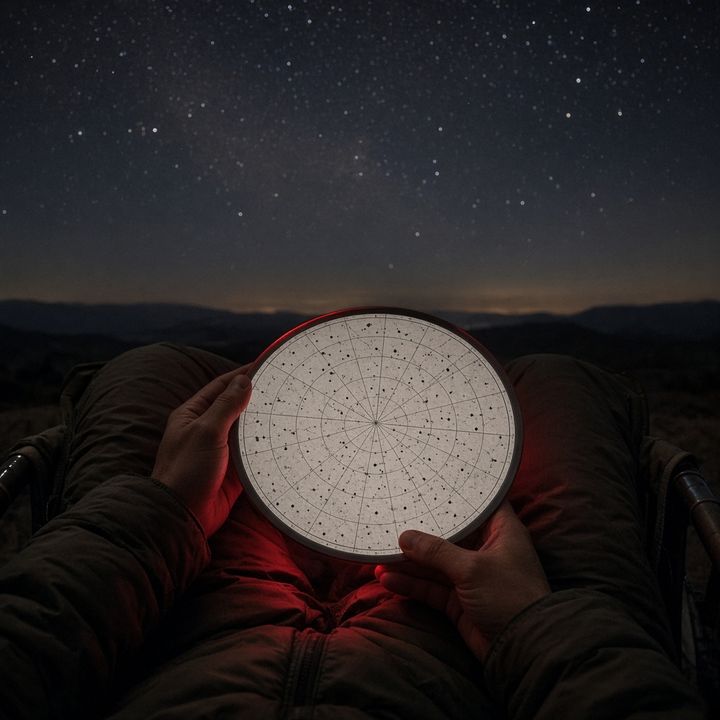
Let your eyes adjust
Your eyes take around 20 to 30 minutes to adapt fully to the dark. A single glance at a bright phone screen or white torch can undo much of that. Use a dim red light, which affects night vision far less, and turn your phone to its night or red-filter mode.
Use averted vision
The centre of your eye is not the most sensitive part in low light. To see a faint star cluster or galaxy, look slightly to one side of it. It often pops into view.
Learn to star-hop
Star-hopping means using bright, easy patterns as signposts to fainter targets. A classic first hop in the northern hemisphere:
- Find the Plough (also called the Big Dipper), seven stars shaped like a saucepan.
- Take the two stars at the end of the pan, known as the Pointers.
- Follow the line they make about five times their separation to reach Polaris, the Pole Star.
- Polaris marks north, and the whole sky appears to turn around it during the night.
Binoculars first
Before buying a telescope, try binoculars. A pair marked 7×50 or 10×50 gathers plenty of light and shows star clusters, the Moon’s craters and Jupiter’s brightest moons. Rest your elbows on a wall or use a tripod adapter to keep the view steady.
How dark is your sky?
| Sky | What you might see |
|---|---|
| City centre | The Moon, planets and the brightest stars |
| Suburbs | Main constellation patterns and a few bright clusters |
| Rural coast | Hundreds of stars, the Milky Way on clear moonless nights |
| Dark-sky site | Thousands of stars, the Andromeda Galaxy and the Milky Way casting faint detail |
Light-pollution maps and officially recognised dark-sky places are a good way to find darker skies near you.
Never point binoculars or a telescope at the Sun unless it is fitted with a certified solar filter made for that instrument. Looking at the Sun through optics can cause permanent eye damage in an instant.